The shift from forty years of declining interest rates to an era of rising interest rates is just starting to play out. The effects will be dramatic. I can’t overemphasize the impact this will have on investing, the economy, and politics. Americans have taken for granted that we can borrow and spend without long term repercussions. The math is really simple. Austrian Business Cycle Theory is very clear as well. The distortions that were created by these artificially low rates need to be corrected. The market will correct them.
Jim Grant has been observing interest rates for a very long time, and is somewhat of an authority on this subject.
“If you want to go back and look at the long cycles, it might just be that the fifty odd years since the end of Bretton Woods and the end of the dollar’s convertibility to gold, that that cycle is ending. It might be that paper money in the historians’ retro perspective views will seem to have been a failure and that the world is going to charge back on unconstrained central bank credit creation and unconstrained sovereign borrowing. Maybe, that’s one way to look at it. It’s the way I tend to look at these things: longer-term, historical trends – and fifty years in the history of money is about the blink of an eye.”
Inflation itself is a form of taxation. It is perhaps the worst possible form, which usually bears hardest on those least able to pay. On the assumption that inflation affected everyone and everything evenly (which, we have seen, is never true), it would be tantamount to a flat sales tax of the same percentage on all commodities, with the rate as high on bread and milk as on diamonds and furs. Or it might be thought of as equivalent to a flat tax of the same percentage, without exemptions, on everyone s income. It is a tax not only on every individual’s expenditures, but on his savings account and life insurance. It is, in fact, a flat capital levy, without exemptions, in which the poor man pays as high a percentage as the rich man.
But the situation is even worse than this, because … inflation does not and cannot affect everyone evenly. Some suffer more than others. The poor are usually more heavily taxed by inflation, in percentage terms, than the rich, for they do not have the same means of protecting themselves by speculative purchases of real equities. Inflation is a kind of tax that is out of control of the tax authorities. It strikes wantonly in all directions. The rate of tax imposed by inflation is not a fixed one: it cannot be determined in advance….
Like every other tax, inflation acts to determine the individual and business policies we are all forced to follow. It discourages all prudence and thrift. It encourages squandering, gambling, reckless waste of all kinds. It often makes it more profitable to speculate than to produce. It tears apart the whole fabric of stable economic relationships. Its inexcusable injustices drive men toward desperate remedies. It plants the seeds of fascism and communism. It leads men to demand totalitarian controls. It ends invariably in bitter disillusion and collapse.
So today I’ll be pivoting from the long term case for optimism to the short term problems that face the economy. Anyone who has studied monetary history, even the basics of monetary history, should be able to recognize, broadly speaking, where we stand today with our monetary system. And once you recognize where we’re at in the cycle of empire and monetary systems, you’ll start to get very concerned about where we’re most likely headed.
First, a little bit of context. When I talk about where we are and where we’re headed, I’m talking in terms of decades. I’ve been discussing this topic for the past 15 years, and I know that lots of people assume that when a person talks about something for 15 years and nothing really happens, that must mean it’s nonsense. But stepping back and looking broadly at monetary history, 15 years is a very short period of time. Immediately after the Bretton Woods Conference in 1944, many leading economists spoke out against the monetary system that was adopted, and said it would end in failure.
They were right. But they weren’t “right” for another 27 years when the system came to an end with the termination of the convertibility of the US dollar to gold. 27 years is a long time in a person’s lifetime…but in the grand sweep of history and monetary systems it’s not really all that long. Defining a long time vs. a short time is subjective and depends on your perspective. Perhaps it would be more relevant to talk about the distinction between something being inevitable and it being imminent.
The economists in 1944 that understood what was happening didn’t say that it would fail imminently, but that it would fail inevitably. The same thing happened with the closing of the gold window in 1971. Austrian Economists then didn’t say that the system would imminently fail, but rather, that it would inevitably fail. That was a long time ago. The system has survived and most Americans are completely oblivious to the damage that the post 1971 monetary system has caused both at home and around the globe. I’ll be posting a lot about gold. The reasons why, will unfortunately, I believe, become all to apparent over the next 15 years. Maybe I’ll be wrong with the timing, but I have a high level of conviction that I won’t be wrong with the inevitable outcome.
If you’re new to the topic of gold and are interested in beginning to understand why it will become important over the next decade or two, the following documentary (in two parts) will give you at least a basic understanding of it’s importance. It can’t begin to completely explain the topic of gold. That would take a lot more time and nuance. But it’s a good start.
My few readers may have noticed a pattern in the posts I’ve made and the articles I’ve linked to so far. That pattern is in pointing out the negative aspects of the current economic and political situation that we find ourselves in. I must admit, that based on my understanding of economic and political history, I believe that this generation is in for some turbulent times in the coming years. I firmly believe this and have been voicing my opinions on it quite vociferously for some time now to family and friends.
But…that doesn’t mean I’m a doomer in regards to humanity and our short-term or, especially, our long term future. Quite the opposite in fact. As such, I plan to write from time to time about why I’m so optimistic about our future. My main reason for starting this blog was to share my ideas about the benefits of freedom and free markets, and the positive economic, ethical, moral, and maybe even spiritual implications surrounding freedom.
One person who has had a profound influence on my life, through his books and articles, is Leonard Read. My blog website is named after one of his profound insights on the nature of spreading human liberty. I will be writing more about some of his insights as time passes on. He had a profound perspective on freedom and human progress that he called “the freedom philosophy.”
Read created an institute to study freedom and he dedicated his life to this cause. A movie could be made about his life. He was instrumental in bringing Austrian Economics to the US and he was personal friends with key people in the movement, including Ludwig Von Mises and Henry Hazlitt. Ron Paul was inspired by Leonard Read and has said that Read was one of the largest influences on his life. Read’s list of personal friends included people ranging from several US Presidents to Walt Disney.
Read was a prolific writer on the topic of freedom. His many articles were turned into books and his complete works are available for free in one e-book here. His books are full of profound ideas, and mention countless books that influenced him. One such example is The Mainspring of Human Progress.
I’ve only been able to find one YouTube video of Read online. It’s a lecture called “How to Advance Liberty,” and it’s a stroke of genius with profound insights that he accumulated during a lifetime dedicated to the spread of human freedom.
I don’t use the word profound lightly. This man’s teachings had a profound effect on Ron Paul, and Ron Paul has had a profound effect on the freedom movement in this country and around the world. I believe Ron Paul will go down in history as possibly the greatest Statesman in American history and be ranked among the leading proponents of freedom in human history.
Anyway, it’s good to step back from all the noise and nonsense prevalent in the media today, to read and learn from people who have been working on behalf of human freedom for centuries. They were optimistic about the future of mankind, and I am too. Truth always wins in the end…always.
Kuppy has interesting takes on macro themes that a lot of people aren’t even considering. Because they’re outlier views, they’re obviously low percentage outcomes. But, as the odds of these types of outcomes rise, it’s important to think through the ramifications.
Once again, this outcome would have dramatic effects on the world as we know it. Personally, I think there’s a high liklihood of this happening, the only question is will it happen during this cycle or during the next cycle or two. Everyone wants to know when it will happen, and I understand that, and would obviously like to know too. From an investing standpoint, that’s the only thing that matters. But I find it fascinating that people are more interested in when it will happen than if it will happen, why it would happen, how it could be prevented, what the underlying reasons are that it will happen, etc., etc.
To me, these are intellectual questions that are far more interesting than what impact it will have on any paticular individual’s investment returns. I think it’s missing the forest for the trees. If you’re not more curious about the why than the when, I’m afraid I can’t help you. And you’re really missing the point.
I genuinely worry that the next crisis, is one that no one here in Western Markets is prepared for. We all live, think, and invest as if we’re a DM. What if we’re an EM, but we haven’t realized it yet?
Think about this the next time you hear some talking head at the Fed talk about their inflation “target.” Inflation is theft, pure and simple. It’s worse than theft in many ways because of the subtlety and deception of it. It is unethical, immoral, uneconomical, and a destroyer of societies. All honest people, especially those that understand it and benefit from it, should denounce it for the evil that it is.
“Inflation makes it possible for some people to get rich by speculation and windfall instead of by hard work. It rewards gambling and penalizes thrift. It conceals and encourages waste and inefficiency in production. It finally tends to demoralize the whole community. It promotes speculation, gambling, squandering, luxury, envy, resentment, discontent, corruption, crime, and increasing drift toward more intervention which may end in dictatorship.” – Henry Hazlitt
Jacob Hornberger takes on one of the sacred cows of politics. It’s easy to be critical of nearly everything that government does, but it’s important to think through what the actual solutions would be if government returned to it’s proper role of securing property rights and letting free people do the rest.
After these government programs become engrained in society, it becomes very difficult for most people to envision a scenario where they didn’t exist. and they can’t imagine doing without them. Ask most voters if they favor Social Security and I think you’ll find very few that would abolish it. Jacob does an excellent job of arguing why it’s just like any other socialist program and should be abolished immediately.
I think Jacob actually understates the amount of ethical and moral damage this program has done to Americans. Social Security bears a lot of the responsibility for undermining some of the core ideas of freedom and a free society. Ideas like future oriented thinking, self reliance, reliance on family, friends, churches, communities and charities. Government charity robs the giver of the meaning and satisfaction of being charitable, and robs the receiver of the gratitude and appreciation for the charity being offered. It replaces the goodwill between giver and receiver with resentment by both parties.
“That’s where genuine care and compassion come from — from the willing heart of individuals, not from the coercive and bureaucratic apparatus of the IRS, income tax, and Social Security Administration. People need to recapture their faith in freedom, themselves, others, and God and abandon their faith in Caesar and his apparatus of coercion.“
Erik Townsend had an interesting guest on this week. Louis-Vincent Gave covers several important topics and his perspective resonated with me. Among other things, they cover:
The current state of the economy in China. US media has been saying that China’s economy is on the verge of collapse for a decade now, and I find that highly unlikely. Louis explains why that’s unlikely.
De-dollarization and the BRICS. I find myself in complete agreement with Louis here. The whole idea about whether or not there will be an announcement at one of these BRICS conferences, at some point announcing a new reserve currency, is completely missing the point. The real point is that de-dollarization is already happening if you simply open your eyes. It’s happening all around us. Countries are trading goods and services in their own currencies, and the more trade that occurs bi-laterally, the less they’ll need the dollar to be in the middle of it. This is a gradual process, and it’s already clearly happening. This will have an impact on the dollar and the US bond market. And that’s putting it mildly.
We’re at a monumental point in world economic history. Major changes are happening all around us, and the US media is not reporting it at all. They have no sense of what is important and what isn’t, and they’re completely oblivious to the economic earthquakes that are happening right under their feet.
And finally, the question on whether Putin will weaponize oil. I could see this going either way, but there’s no question that it’s a possibility. I’d put it at less than 50/50, but if it happens, it’s impossible to overstate the impact it would have. It would also quite likely lead to a bi-polar world in terms of trade.
These are big topics, and it’s impossible to do them justice with one podcast or a few blog posts, but the world will be very different 10-20 years from now than it’s been for the last 50 years. It’s time to open your eyes and recognize that change is coming…
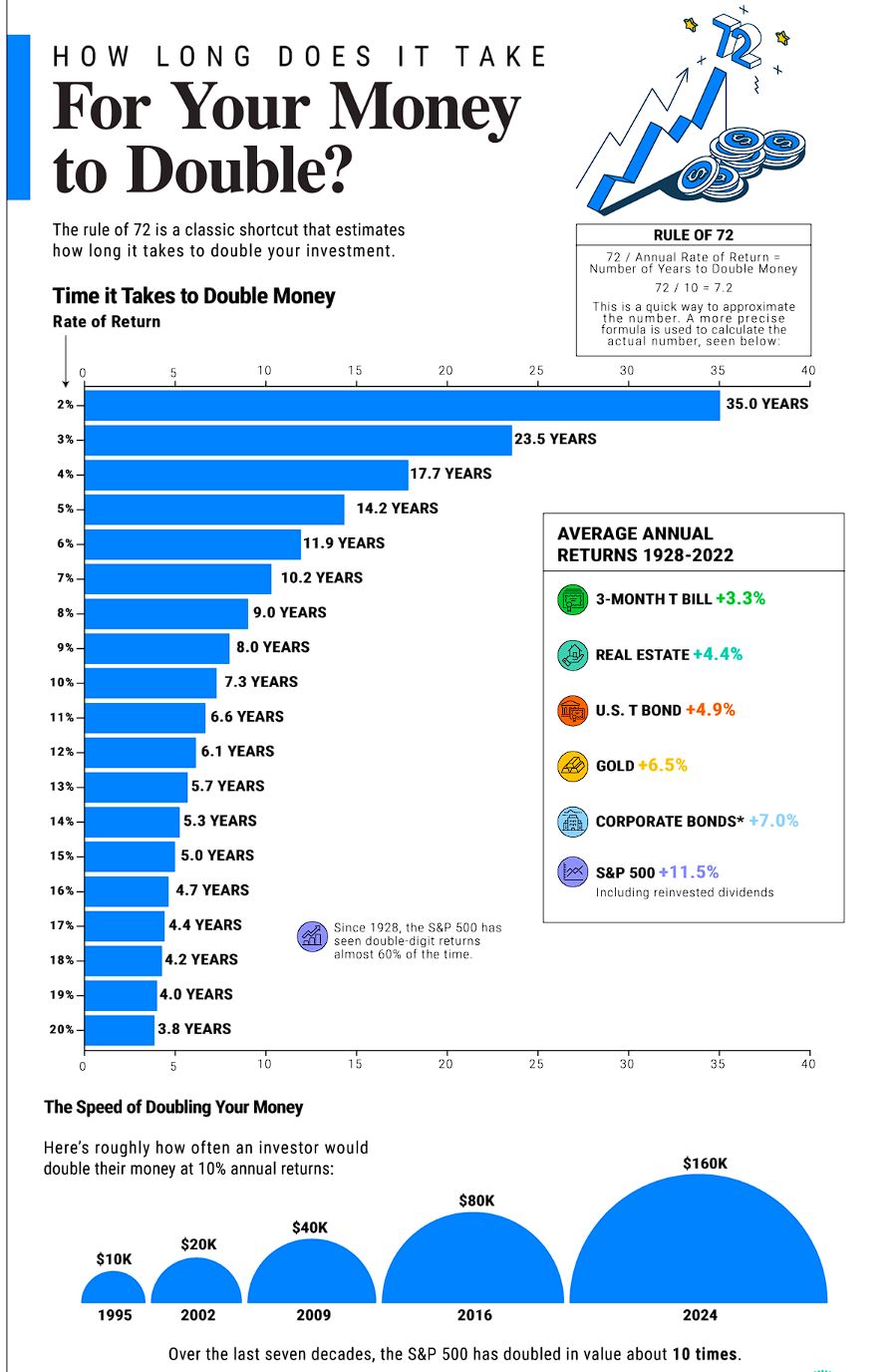
The rule of 72 is a great mental tool that a lot of non-financial people aren’t aware of. It’s something I’ve used repeatedly when thinking about investment returns. Here’s a neat graph laying out the concept with some additional info on long term returns of different assets.

 It's A Learning Problem