The immigration crisis…

Jacob Hornberger with an interesting take on all the sturm and drang regarding the Mexican border.

Why is it impossible to come up with a “comprehensive immigration reform” plan that will work? The answer is simple: America’s immigration system is a socialist system. It is based on the core socialist principle of central planning. Government officials plan, in a top-down, command-and-control manner, the movements of millions of people in one of the most complex labor markets in history.

It simply cannot be done. As the libertarian Nobel Prize–winning Austrian economist Friedrich Hayek observed, central planners have a “fatal conceit.” They actually think that they possess the requisite knowledge to centrally plan complex economic activity.

-Jacob Hornberger
Posted in Freedom, Government | Leave a comment

The Bitcoin ETF…

So, finally the Bitcoin ETFs have arrived. After months of rampant speculation, the SEC finally approved what bitcoiners have been waiting for. I find it amusing that Gary Gensler went out of his way to cover his own derriere at the same time as he’s approving the etfs. He’s making it super clear that when this all ends badly, the SEC is not to blame.

While we approved the listing and trading of certain spot bitcoin ETP shares today, we did not approve or endorse bitcoin. Investors should remain cautious about the myriad risks associated with bitcoin and products whose value is tied to crypto.

-Gary Gensler

I continue to be amazed at how completely blatant the ponzi is, and how the mania to get-rich-quick makes it easy to ignore the facts about bitcoin. I’ve already discussed it in the past and don’t feel the need to regurgitate the same arguments.

I’m probably suffering from confirmation bias on this topic at this point, but here’s another article that I encountered today that lays out the facts rather coherently:

“Real money goes in, nothing is created, and real money is consumed by the owners of the exchange and their employees. Investors get nothing but some code that people keep telling them has value and will keep rising in price because it is digital and supply is limited so as long as demand exists, the price will rise. Any money taken out must come from new money going in since the tokens create nothing and the crypto miners consume computer and energy to “mine” the next Bitcoin. Any scheme where you invest money but your return depends on someone else investing at a greater price to provide the money you want to receive is a classic Ponzi scheme.

As the “rake” of expenses and fees of crypto exchanges and their owners and employees depletes the cash on hand, and no profit is created by anything that Bitcoin or exchange owners do with the money they take in, a “run on the bank” is not just likely but inevitable. At that point, the dream of a deregulated peer reviewed ledger replacing fiat currencies backed by the full faith and credit of the U.S. government turns into a nightmare of bankruptcies, business failures and years of litigation to clean up the remains.


Bernie Madoff would be proud.”

-Michael Blair
Posted in Bitcoin | Tagged , , , , | Leave a comment

Tone deaf…

There’s a reason I keep coming back to two themes. One is the non-aggression principle and the other is Bastiat’s seen vs. the unseen. Here’s a good example of why I’m so obsessed with these two ideas. Watching this is, quite frankly, infuriating. 

If you don’t have time to watch the entire video, just watch it from 53:45 thru 55:22. Francis Collins admits that they didn’t even consider the negative consequences of their actions. It is truly pathetic. Even if their actions created massive collateral damage, they didn’t consider it and didn’t care.

When you combine a violation of the non-aggression principle with someone who’s completely ignorant about the seen vs. unseen, you get some truly horrific results. The entire Covid-19 debacle is as good of a case study as you’re ever likely to see. And the outcome was entirely predictable from day one. Covid-19 was actually a good test to see if people understood either of these two ideas. Anyone who was in favor of lockdowns, at any time, clearly failed the test.

When this entire Covid-19 debacle began, it was completely obvious to me, and anyone else who understands the non-aggression principle, that the government was going to do way more harm than good. The reason was obvious: there was no possible way that anyone, no how matter how intelligent or well-intentioned they were, could possibly have enough information, not so much about the virus, but more importantly, about the infinitely complex circumstances of eight billion people in the universe, to create a net positive outcome with the initiation of aggression. 

There was no possible way that anyone, especially the government, could know what the second, third, and fourth order effects were going to be from their initiation of aggression. And make no mistake about it, the government clearly violated the only legitimate function of government: the prevention of the initiation of aggression. They became the very thing they were supposed to protect against. They became a monster, initiating aggression on a massive scale.

Even with the benefit of hindsight, most of these people refuse to accept that they were wrong for supporting lockdowns and the censorship of people opposed to them. This is not complicated. If you were ever in favor of lockdowns you were wrong. If you were ever in favor of censorship and violating free speech, you were wrong. History could not be any more clear on this. You didn’t understand the complexities of human action and you can’t be trusted to ever again be in a position of authority.

People in favor of censorship were the bad guys. Just like every other time for thousands of years. Whenever someone wants to censor free speech, they are, by definition, the bad guys. I mean, can we at least agree on this? How pathetic is it that this is even up for debate?

How far have we strayed from the advice of the Founders regarding the importance of free speech?

For example, Thomas Jefferson concludes his Religious Freedom Bill with words expressing his unshakeable faith in the power of reasoned debate to distinguish truth from error, words that are inscribed in marble on the Jefferson Memorial in Washington: “truth is great and will prevail if left to herself; she is the proper and sufficient antagonist to error, and has nothing to fear from the conflict unless by human interposition disarmed of her natural weapons, free argument and debate.”

Thank goodness we still have a Bill of Rights in this country. It is shocking how few people actually believe in these rights, especially people in government.

Posted in Freedom, Government | Tagged , , , , | Leave a comment

Mark Spitznagel…

Mark Spitznagel is a really interesting character. I’ve read several of his books, this one most recently, and he has some really interesting ideas on investing and risk. He’s worked with Nassim Taleb and they seem to share a lot of the same perspectives. Nassim has written about “black swans” and risk management extensively. I found his “Antifragile” book to be interesting as well.

Mark is also clearly a student of Austrian Economics. I’m always trying to think of ways to apply the theory behind Austrian Economics to the real-world challenges of investing. While they’re two different things, I believe there are some key insights that can be applied to improve investing results. I plan to write a post sometime about how I incorporate his ideas on investing into my own portfolio. 

But, thats another post for another day. In the meantime, here’s an interview I found from a few months ago…

And a few blurbs:

We are in the greatest credit bubble of human history. That’s the real problem. It’s entirely because of artificially low interest rates, artificial liquidity in the economy that has really happened in a big way since the great financial crisis. And credit bubbles end. They pop. There’s no way to stop them from popping. Debts need to get paid or they end in default. And of course, the debt burden today is at a level that cannot be repaid. You can just look at total debt as a function of the economy; it’s never been greater. I don’t think there’s really any way to objectively argue against these points. So it’s the greatest credit-market bubble we’ve ever seen. I have no confidence in how it’s going to end or when.

This is the most dangerous time in the markets ever. It has nothing to do with what’s going on in the Middle East, though. It has everything to do with what’s going on in Washington, D.C. The Fed has created a tinderbox time bomb and the greatest credit bubble in human history. And I do not think anybody would disagree with what I just said. But it doesn’t mean you shouldn’t be long on the market

Crypto is the ultimate risk asset. Bitcoin is just purely a castle in the air. I’ll buy it because I think you’re going to buy it from me — it’s the greater-fool theory in the purest, purest sense. And that’s fine; it’s a great punter’s pure risk asset, and it serves that function. I think it ultimately has very little utility. It’s a good indicator in many ways; it’s not a safe haven, okay? It’s the opposite of a safe haven. It would be a position against which you would need a safe haven.

Posted in Bitcoin, Investments | Tagged , , | Leave a comment

I, Pencil…

This essay by Leonard Read conveys a very powerful concept or principle in an incredibly simple way. The power of parables to convey principles is incredible. Some of the best teachers in all of history have used this method. It is clearly one of the most effective ways to teach principles. The concept that free minds and free markets organize everything in society in ways that are almost unimaginable is really powerful. Understanding the tremendous complexity created by 8 billion human beings peacefully interacting together without any top-down control is a nearly religious experience.

I hear lots of people say they understand this, but I question how many of them have really grasped how profound it is. How many people have really thought this idea through? How many have asked themselves what this implies about politics, about religion, and about nature? How many people have inverted this idea and asked themselves what life would be like if the opposite of this principle were true?

Suppose, for instance, that the way to prosperity, progress, and happiness for the masses were if people were willing to abandon the idea of mental and physical freedom? Suppose everything would work better in the world if we all agreed to be the ideological and physical slaves of great “leaders” through the threat of violence? Suppose the top-down, total control of totalitarianism, would actually outperform free societies? Would we then say “oh, obviously that’s the best way to organize society” and all fall into line like obedient slaves? Would we struggle with whether it’s better to live in a free society and fall behind materially and spiritually, versus living in a state of servitude where we would benefit materially and spiritually?

Have we ever even paused to think about how fortunate we are not to have to make that decision?

How profoundly fortunate are we that we live in a universe that not only provides us with the ability to freely think, speak, associate with other people, work, worship, etc., etc., in whatever way our conscience guides us towards, and that the results are infinitely better than if the alternative were true?

It’s miraculous!

Understanding this thoroughly does have religious implications. That the creator of the universe designed a system that works this way has profound implications about how we, as human beings, should go about organizing all of our organizations, from the nuclear family, to businesses, churches, to non-profits, to communities, to local, regional, and national governments.

The lesson should be crystal clear: using coercive force results in disorder, chaos, pain, and immorality. Maintaining freedom for individuals to choose and interact voluntarily unleashes creativity, order, beauty, morality, material and religious progress, happiness, vibrancy and wonder in our universe.

When was the last time you were in a discussion with someone about politics or religion and someone brought up this idea of freedom being the way to measure what the correct course of action should be? Does anyone even consider this anymore? How far has our society fallen when we don’t even consider principles when we’re talking about these topics?

Freedom is an amazing thing. Lots of people give it lip service, but few people think about it deeply. If they did, our world would be a very different place. The fact that freedom is not only powerful, but also is good and is the state that the Creator designed man for, is evidenced everywhere. This fact is revealed by the Creator thru both scripture and nature, in ways that are unmistakable. Even a child can understand this.

Leonard Read’s classic essay, I, Pencil, captures this beautifully.

There is a fact still more astounding: the absence of a mastermind, of anyone dictating or forcibly directing these countless actions which bring me into being. No trace of such a person can be found. Instead, we find the Invisible Hand at work. This is the mystery to which I earlier referred.

It has been said that “only God can make a tree.” Why do we agree with this? Isn’t it because we realize that we ourselves could not make one? Indeed, can we even describe a tree? We cannot, except in superficial terms. We can say, for instance, that a certain molecular configuration manifests itself as a tree. But what mind is there among men that could even record, let alone direct, the constant changes in molecules that transpire in the life span of a tree? Such a feat is utterly unthinkable!

I, Pencil, am a complex combination of miracles: a tree, zinc, copper, graphite, and so on. But to these miracles that manifest themselves in nature an even-more-extraordinary miracle has been added: the configuration of creative human energies — millions of tiny know-hows configurating naturally and spontaneously in response to human necessity and desire and in the absence of any human masterminding! Since only God can make a tree, I insist that only God could make me. Man can no more direct these millions of know-hows to bring me into being than he can put molecules together to create a tree.

The lesson I have to teach is this: Leave all creative energies uninhibited. Merely organize society to act in harmony with this lesson. Let society’s legal apparatus remove all obstacles the best it can. Permit these creative know-hows freely to flow. Have faith that free men and women will respond to the Invisible Hand. This faith will be confirmed. I, Pencil, seemingly simple though I am, offer the miracle of my creation as testimony that this is a practical faith, as practical as the sun, the rain, a cedar tree, the good earth.

Leonard Read

Posted in Freedom, Philosophy/Religion | Leave a comment

Jordan Peterson and Anarchism…

So after watching this discussion between Jordan Peterson and Michael Malice, I feel compelled to comment on it. First of all, I’m simply stunned that Jordan has obviously never clearly thought through the idea of the non-aggression principle. I find this absolutely stunning.

I’ve mentioned in previous posts that I have a love/hate relationship with Jordan Peterson. I’d like to explain why in a little more detail before discussing this Malice conversation. The loving Jordan Peterson part is because I admire quite a few of the things he’s done and positions he’s taken. His stance on free speech for instance, is rock solid. His being willing to lose his job as a professor by taking a principled stance and refusing to back down regarding free speech is commendable. His recognition of how fundamental free speech is to western civilization and his recognition of the horrors of communism show how deeply he’s thought about some very important issues. He’s excellent in his understanding of, and opposition to cultural Marxism.

His views on the meaning of certain biblical texts and their importance and relevance in the 21st century regardless of whether a person is a practicing Christian or not, are also interesting and fascinating. I think he’s done more to try to bridge the gap between the long-simmering conflict between science and religion for this generation of youth than anyone else that I’m aware of. His interpretation of biblical texts and symbolism has helped a lot of people who lost faith in the Bible when they studied science and felt the tension between a material world and the spiritual world. He’s helped a lot of people who were ready to “throw out the baby with the bathwater” reconsider and look at the Bible not merely as an ancient text, one that is no longer relevant and maybe just a work of fiction, to reconsider the Bible through a much more sophisticated and nuanced spiritual view. I think he has brought a lot of youth back from the brink of nihilism and meaninglessness to a point where they see purpose and ultimate meaning in their lives again. For all of this I give him tremendous credit.

At the same time, I think he tends to overthink things and unnecessarily overcomplicate a lot of his arguments and I don’t think this helps him. I realize that this is a broad statement and kind of unfair without giving specific examples, but maybe I’ll do that more in depth at another time. But I believe he does this with some of his psychological arguments as well and I know that he does it in other arguments that he makes on more secular issues.

This brings me to the hating part of the relationship. Obviously hate is too strong of a term here, but you get the point. Where I find him hopelessly in over his head are his takes on politics, foreign affairs, and economics. He’s been discussing these topics a lot lately and quite frankly, a lot of his opinions in these areas are simply mind-bogglingly bad. I’ve commented before on how bad some of his economic takes are, but I think in these areas it’s really almost impossible to separate the bad takes. And I think I understand the fundamental mistake he’s making that is leading to these bad takes. He simply does not understand the non-aggression principle. I know that seems like a simplistic argument, but I think that is the fundamental problem.

Maybe it’s just confirmation-bias on my part. After all, that is one of the main points of this blog. It’s to help me learn and to share the importance of the non-aggression principle in as many ways as I possibly can so that hopefully a few more people can understand it’s significance and all the implications to be derived from it.

So, let’s get back to the Michael Malice interview. The first half or so of the interview is centered around their discussion of Malice’s book about Soviet Communism. Here they have very little disagreement and it’s somewhat interesting, but I didn’t really learn anything new. It’s the second half of the interview where they start talking about voluntarism, anarchism, and libertarianism where Peterson clearly reveals that he doesn’t understand any of these terms clearly. You can see him trying to understand what Malice is saying and he struggles to wrap his mind around the concepts. Malice effortlessly brushes asides all of his objections without even making a concerted effort. Peterson struggles to understand the importance of private property. He struggles to define what force is. He tries to complicate the issue by adding numerous wrinkles to Malice’s arguments, for example, implying that something fundamental changes when it’s ten people having a conversation rather than just two. You can see the lightbulb starting to come on several times, but he keeps overthinking it and trying to complicate it. Malice just repeatedly destroys every objection that he has rather effortlessly.

Peterson clearly is familiar with at least some of the concepts. He talks about the idea of time preference, so clearly he is not completely ignorant about some of the foundational ideas of where economics and psychology collide. They actually have a good discussion about time preference. This is an absolutely critical concept to understand if you want to understand anything about economics or morality. But I’m simply astounded by the fact that he doesn’t seem to have ever really thought through the deeper implications and the connections between private property, the non-aggression principle, free markets, morality, Christianity, western civilization, and so forth. How could someone as educated as Jordan Peterson, someone who has studied psychology, ethics, morality, communism, capitalism, and western culture as much as he has, not ever have given this idea of the non-aggression principle more thought than he has? 

How can someone like Peterson, who has read Ayn Rand, studied evolutionary psychology, seems to understand Hayek’s Use of Knowledge in Society problem, understands the horror of totalitarianism…how can he not understand that the fundamental issue, the elephant in the room, and the theme that binds them all together, is the question of the appropriate use of force? It absolutely astounds me that he can’t seem to make this connection.

This principle underlies all of classical liberalism, America’s Bill of Rights, sound economics, not to mention western civilization, nature, and Christianity. I’ve always wondered how someone who is so brilliant in many areas can be so completely lost in several other areas that seem very relevant to his field of expertise. Now, I guess I know. He simply has never clearly considered them from the angle of the non-aggression principle. I find that simply shocking, but at the same time, somewhat hopeful. After all, imagine the impact it could have on his understanding in other areas, and also, probably more importantly, if Jordan Peterson doesn’t understand this, how many other people don’t understand it? 

It means that we are among an incredibly small minority that understands this. It means that there is a tremendous need for all of us to try and understand this principle better so that we can better share it. It means that if you understand it, you have a moral responsibility to understand it more clearly and help to disseminate it. That, is incredible, and simply amazing!

I’ll end with a Mises quote that I’ve often used before, but which seems appropriate here:

“Everyone carries a part of society on his shoulders; no one is relieved of his share of responsibility by others. And no one can find a safe way for himself if society is sweeping towards de­struction. Therefore everyone, in his own interests, must thrust himself vigorously into the intellectual battle. No one can stand aside with unconcern: the interests of everyone hang on the result.”

Posted in Government, Philosophy/Religion | Tagged , , , , | Leave a comment

Why Sprott Uranium Trust…

Here’s why SRUUF is one of my ten current investment holdings. I haven’t done a huge amount of research on this holding and it has been the most recent addition to my holdings. I’ve been watching uranium for a while now, but I haven’t really found a compelling company that I feel would be a good fit for me. Because of this, I decided to simply buy the Sprott Uranium Trust. It seems like the simplest, most direct way to benefit from uranium going higher.

Harris Kupperman has been pounding the table on uranium for a while now, and he’s one of the reasons I finally started doing more research on it. My entire thesis is spelled out much better by him than I can convey by writing a long article, so I’m just going to link to an interview that he did that I found particularly compelling. 

The interview itself is actually very humorous in it’s own way. We forget sometimes how different our perspectives are as investors as opposed to someone who has no interest in finance. Hearing these two people discuss investing in uranium at a nuclear energy conference surrounded by nuclear physicists who have no concept of what they’re talking about is hilarious. Here’s that interview…

Posted in Investments | Leave a comment

The Bitcoin Bubble…

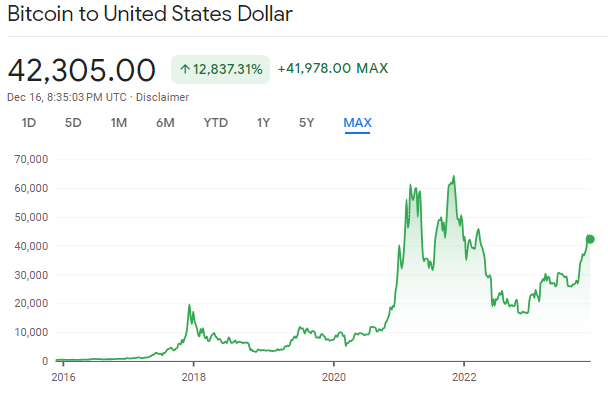
I thought I should do a post about bitcoin again since it’s been on a little run lately…

Back when I did my debate about it on May 25, 2023 it was trading at around $29,000.00, so it’s up about 45% since then. I’ve had a few people ask me recently if I’ve changed my mind on it at all since then. I’ve told them all no. I haven’t seen any facts since then that would lead me to consider changing my mind on it. In fact, the price action since then seems very reasonable given that the Fed still hasn’t popped the everything bubble that we’re living in. Stock markets are nearing all-time highs and bitcoin is doing what one should expect a ponzi-bubble to do in this environment. As I said during the debate, bitcoin could go a lot higher before it ultimately fails.

Name calling aside, I still find the entire crypto mania fascinating. It’s a great story, one that has lots of things going for it, and anyone interested in economics will be absolutely fascinated by it. I stand by my original points that I made in the debate, namely that it has three primary problems that it faces: economic problems, governmental problems, and technological problems. I’m most interested in the economic law problems that I believe it faces. My argument from day one has been that it violates Mises’s regression theorem. That is the fundamental problem and because it violates the regression theorem, it will never be stable, and that is why it is a ponzi, doomed to failure in the long run.

Crypto currencies are one more story in the long story of money historically, and I believe they could absolutely lead towards long-term changes in money. Hopefully those changes will be something positive like a market driven, gold-backed crypto currency that is not centralized around a single custodian, but rather around multiple competitive custodians. This, or something like this, could be a profound breakthrough in the cause of human liberty.

On the other hand, it could also lead to something like Fed-coin, which would be a central bank issued crypto-currency. This would be a terrible destroyer of human freedom and could lead to very dangerous centralized control on a truly horrific scale. I believe that crypto-currency is just like any other technology in that it can be used for good or for evil. The ultimate outcome will be determined by both the understanding as well as the intentions of individual human beings. In the meantime, some people will make a lot of money from the ponzi, while the majority of the naive people speculating in it will lose lots of money. As Warren Buffet has said repeatedly, this won’t end well.

Following is a well thought out essay by someone whom I respect very much. Dan Oliver is someone who has studied money and history at a very deep level, and he possesses the rare ability to write about these topics in a clear and thorough manner. He sees bitcoin very much in the way that I do and he wrote this article back in 2017. 

“Bitcoin’s shortcoming is fatal: its quantity commitment is in no way a quality
commitment. It is rational to hold bitcoin only to the extent one thinks it is stable or
rising in value. It clearly is not stable, and it will rise in value only to the extent that
market participants either expect that it will one day be stable to fulfill its purpose as
money or expect that someone else will pay a higher price for it—i.e., an expanding
bubble.
Bubbles form only when there are easy monetary conditions and often around
generally hard-to-value new technologies: the canal, the railroad, radio, the internet,
and now blockchain technology. The parallels with blockchain and the internet bubble
are manifest, in fact. Casting the mind back to 1996, few people knew what “an
internet” was or why it was useful or how to get one. But there were already fortunes
being made by young innovators. It wasn’t long until wholesale money wanted in
on the game and began funding all sorts of crazy internet start-ups. When these
companies listed, Pets.com and theGlobe.com spring to mind, the public was able to
join the growing bubble to drive it to insane heights before it was left holding the bag
in the crash.”

Posted in Bitcoin, Freedom | Leave a comment

Ludwig von Mises…

How one carries on in the face of unavoidable catastrophe is a matter of temperament. In high school, as was custom, I had chosen a verse by Virgil to be my motto: Tu ne cede malis sed contra audentior ito (“Do not give in to evil, but proceed ever more boldly against it”). I recalled these words during the darkest hours of the war. Again and again I had met with situations from which rational deliberation found no means of escape; but then the unexpected intervened, and with it came salvation. I would not lose courage even now. I wanted to do everything an economist could do. I would not tire in saying what I knew to be true.

“The great social discussion cannot proceed otherwise than by means of the thought, will, and action of individuals. Society lives and acts only in individuals; it is nothing more than a certain attitude on their part. Everyone carries a part of society on his shoulders; no one is relieved of his share of responsibility by others. And no one can find a safe way out for himself if society is sweeping towards destruction. Therefore everyone, in his own interests, must thrust himself vigorously into the intellectual battle. None can stand aside with unconcern; the interests of everyone hang on the result. Whether he chooses or not, every man is drawn into the great historical struggle, the decisive battle into which our epoch has plunged us.”

Posted in Freedom, Quotes | Leave a comment

Why Minera Alamos…

I promised several weeks ago to write brief posts on each of my ten current stock holdings. This is the first post and it’s about one of my favorite speculative stocks that I own.

So, why Minera Alamos?

Well, for one thing, quite a few people who I’ve followed on fintwit for years, and who I’ve come to respect, are invested in the company. Already, this is a controversial part of my investment thesis. Lot’s of people will tell you that you can’t rely on anyone else and that you have to do the due-diligence yourself. This is true of course. But a large part of the due-diligence is finding people who have been doing it longer than yourself and seeking out their advice. The reality is that in any area of publicly traded companies, there is a massive amount of research you’ll need to do to really understand an industry and specific companies.

Knowing people that are smarter than you, and who have more experience in an area, is tremendously beneficial. The kind of people who I follow in the mining industry have vastly more experience than I do. These are people who are geologists, metallurgical experts, former mining executives, etc., etc. Many of these guys are actually out in the field and have been to the mines themselves. It would take a lifetime in the industry to be able to acquire their knowledge. That’s simply not realistic for myself. What is realistic is finding these people, following them long enough to find out how knowledgeable they really are, and then listening to what they have to say and comparing it to my own due-diligence. I’ve found fintwit to be an incredible asset here, and I’m taking advantage of that.

Most of my reasons for owning the stock are detailed fairly well in the article below. But here are the bullet points:

  • They seem to have a competent and ethical management team.
  • Doug Ramshaw, the company President, is putting his money where his mouth is. He’s been continuously buying shares in the open market for years. This is unusual in this industry.
  • They have a business philosophy that resonates with me. They believe that it’s not about how many ounces you mine, but rather, it’s about how much can you make per ounce. In other words, it’s about getting to profitability as soon as possible and than using that profit to fund future expansion.
  • Their team has a proven track record of creating profitable mines in Mexico.
  • They have a solid balance sheet.
  • They haven’t diluted their shareholders.
  • They’ve had a consistent story from day one and they’ve stuck to it through the past several years despite some setbacks.
  • It has the potential to be a multi-bagger and there are lots of catalysts in the near future (12-24 months).

This article is from nearly 18 months ago, so it’s kind of old news. But it’s a good article explaining why I consider Minera Alamos to be an interesting speculative investment. When this article was written, Minera was trading at around a $220 million market cap. It’s trading at less than half that today. But I don’t think the fundamental story has changed at all. They’re still on target to do everything this article talks about.

True, the timelines have slipped by a good bit since then. Some of the reasons the timelines slipped were out of their control. And it’s still highly speculative. But…it may be the best setup for a junior minor that I’ve seen in quite a while when you consider risk vs reward. They’ve done a good job of managing their balance sheet. They haven’t diluted shareholders. So all of the upside potential is still there. They just need to have a few things go right, starting with permits for expanding Santana, and for the mine at Cerra de Ora, and I think it will be off to the races. In order to find 10-baggers, you need to take some risks. And 10-baggers are often created by negative sentiment from temporary setbacks, which in turn creates the drawdown in market cap which then allows you to put on a large position.

Needless to say, I’ve got a large position in this one. I’ve been averaging into this position for the past two years. Holding it for several years allows you to understand the story and get comfortable with the risks involved. Sometimes, in investing, when you feel the odds are on your side, you just need to take a swing. I’m taking a swing. I think I’ll know if it’s a winner or loser within the next year.

How Minera Alamos Turns $20 Of Exploration Spending Into $2,000 Of Gold

And here is an update from their President from earlier this year where he lays out the thesis:

Posted in Gold, Investments | Leave a comment