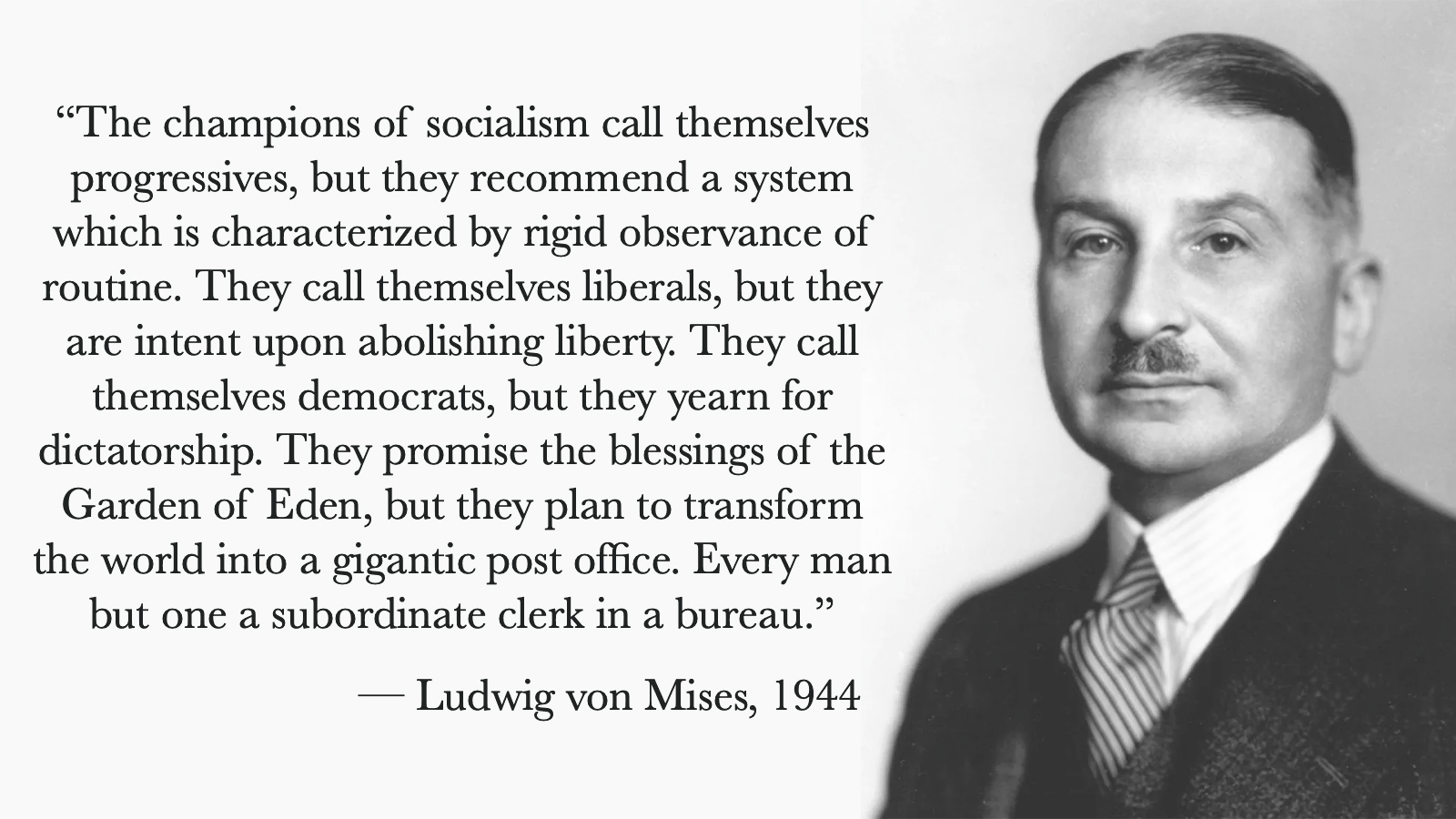
When definitions no longer matter…

Posted in Government, Quotes | Leave a comment

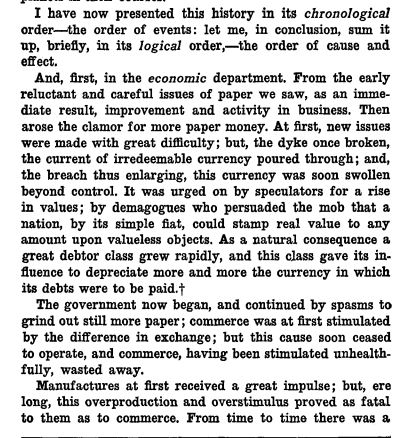
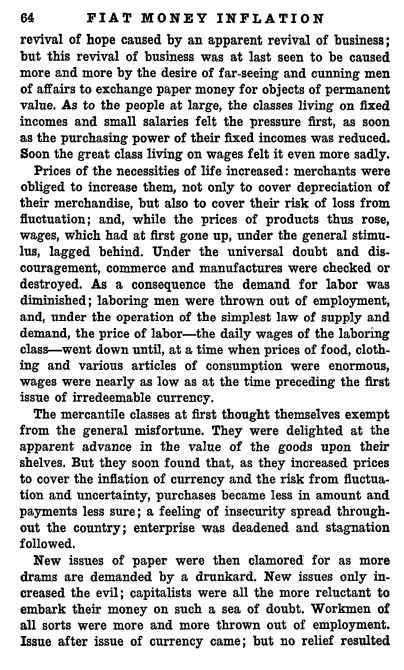
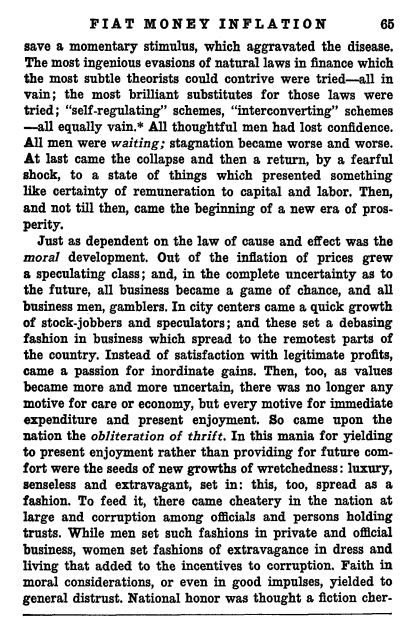
Fiat Money Inflation…

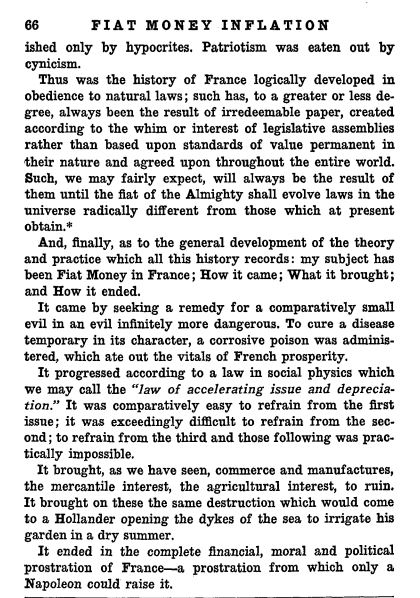
This book really is a must-read for anyone interested in inflation and it’s effects on society. It’s a short, easy read, and it’s available for free here: Fiat Money Inflation in France.

Below are snapshots of some of the conclusions:

Posted in Gold, inflation | Leave a comment

Getting left behind…

No, not that left behind. I’m talking about getting left behind financially. Kuppy reposted a blog post by Erik Renander called Bad is Good. It talks about the eerie similarities between the inflation in France in the late 1780’s and what we’re seeing now.

He takes excerpts from a book, Fiat Money Inflation in France by Andrew Dickson White, and contrasts some of his points to our current situation. I read the book numerous years ago when I read multiple books trying to determine what has happened in the past during great inflations. It is a fairly short and easy read that I would recommend to anyone trying to understand the mindset of societies in the grips of over indebtedness and inflation. Everyone is familiar with Weimar Germany, but this book does a great job of describing similar conditions in France over 100 years prior to the great inflation in Weimar. Amazingly, this came less than 70 years after France endured John Law and the Mississippi Bubble fiat currency debacle. If you study history you’ll find this happening over and over again.

The article does a great job of contrasting what was being said then and what we’re experiencing now. The similarities are alarming to say the least. The resistance to money printing at first. The gradual cries for more money printing when nothing “bad” happens initially. How inflation starts to change the culture and how the culture turns in on itself as the disease progresses. The obsession with trading and speculation. Bitcoin and crypto are the obvious parallels here. The total corruption of the political class. And that all leads to the getting left behind part.

Our society is starting to sense, with a growing unease, that life is getting harder for working class people and for young people especially. People are sensing that something is wrong with the money and the fact that asset prices just keep soaring while they’re getting squeezed. History rhymes but doesn’t necessarily repeat so one needs to be careful about making assumptions about the future. But, it seems to me that we’re just beginning the phase where more and more people are going to catch onto the idea that if you ever want to get ahead in this economy you’ll need to lever up and take more risk. This goes against people’s natural aversion to loss and the idea of levering up into what is clearly an asset bubble is frightening.

Nevertheless, as time goes on and the wealth disparity increases between those who were prudent, who saved, invested conservatively, and waited for the inevitable pullback, and those who took on leverage and speculated aggressively becomes larger, it will cause more division and more tension. This isn’t just speculation; our culture is already developing terms for it: FOMO and YOLO. These inclinations are spreading and they are not healthy.

Jay Powell is already hinting at cutting rates at a time when inflation is still clearly not under control. It feels like the rampant speculation is just beneath the surface and getting ready to roar again as soon as he blinks. At the same time, we know from previous historical examples, that there will be terrifying pullbacks in asset prices as the instability accelerates. The question everyone wants an answer to is what the individual should do to protect himself or herself.

There are no good answers. While we’ve seen this movie before, we truly are in uncharted waters given that this time the entire world finds itself in a predicament where in the past it was individual countries. Every individual’s situation is unique. What will work for one person may not necessarily work for the next. The only suggestion that I have to offer is to educate yourself. The dice have been cast and there is no turning back. The vast majority of people are totally unaware, and most of those that have some inkling of what is happening would rather ignore it and hope for the best rather than do the hard work of educating themselves and taking precautionary measures. I certainly sympathize with them, but sympathy won’t help them. They need to take action. Otherwise…

The question will naturally be asked, On whom did this vast depreciation mainly fall at last? When this currency had sunk to about one three-hundredth part of its nominal value and, after that, to nothing, in whose hands was the bulk of it? The answer is simple.

Financiers and men of large means were shrewd enough to put as much of their property as possible into objects of permanent value. The working classes had no such foresight or skill or means. On them finally came the great crushing weight of the loss. After the first collapse came up the cries of the starving.

Fiat Money Inflation in France

Posted in Investments | Tagged , , , , | Leave a comment

Adam Smith quote…

Some things are timeless. The constant struggle between the natural progress of free human beings and the misguided coercion initiated by governments acting beyond their moral roles continues, just as it has for thousands of years…

“The uniform, constant, and uninterrupted effort of every man to better
his condition, the principle from which public and national, as well as
private opulence is originally derived, is frequently powerful enough to
maintain the natural progress of things towards improvement, in spite
both of the extravagance of government and of the greatest errors of
administration. Like the unknown principle of animal life, it frequently
restores health and vigour to the constitution, in spite, not only of the
disease, but of the absurd prescriptions of the doctor.”

Adam Smith
Posted in Freedom, Government | Leave a comment

Friedrich August von Hayek…

F. A Hayek was an Austrian-British economist, political philosopher and an influential contributor to the Austrian School of Economics. His most popular work, The Road to Serfdom, was widely circulated in the United States.

After serving in an artillery regiment in the Austro-Hungarian war, in which he was decorated for bravery, he decided to pursue an academic career. Hayek said of his experience during the war “The decisive influence was really World War I. It’s bound to draw your attention to the problems of political organization.”

We Americans really have no appreciation for the turmoil that wracked Europe during the 20th century. Multiple generations of Europeans were thrust into political and economic disaster during two major world wars. We have no concept of how pressing the issues of politics and economics must have been to young men growing up through these events and being dramatically impacted by the insanity of bad economic and political philosophies.

When you read about Hayek’s education and the people he was taught by and interacted with, you get a sense of how intellectually stimulating it must have been. He studied at the University of Vienna, which at the time was one of the leading universities in the world. Given the dismal state of our universities today, it is amazing to read about the people he interacted with and the discussions they must have had about real-world challenges.

Hayek was initially sympathetic to democratic socialism, but after reading Socialism by Mises, he began attending Mises’ private seminars. Hayek said of the book, Socialism: “It was a work on political economy in the tradition of the great moral philosophers, a Montesquieu or Adam Smith, containing both acute knowledge and profound wisdom…To none of us young men who read the book when it appeared was the world ever the same again.”

What an amazing complement to Mises. I can certainly relate to that sentiment. After discovering the works of the Austrians the world has never appeared to me the same again either. Hayek later attended the London School of Economics, and was thrust right into the middle of characters and ideological battles that would create the current international economic order during and after World War II.

With that little bit of background, I want to share several of Hayek’s most powerful ideas. They were the ideas of spontaneous order, and the use of knowledge in society.

They are discussed here by Richard Ebeling and Jacob Hornberger:

I don’t like to abuse the word profound, and I know I keep using it over and over, but these two ideas are truly profound. The implications of these two ideas are broad ranging and open up an entire world of insights into many other topics that I plan to write about in future posts. It is amazing to me that given how much information we have access to with the internet, Youtube, podcasts, social media, etc., that ideas like this aren’t being discussed in our society.

The impacts of ideas like these on everything from politics, business, economics, education, religion, etc., etc., should be profound. Instead, not only are they not discussed, but hardly anyone I know has even heard of them, much less considered them deeply for their implications. The level of discourse in our society is incredibly shallow and superficial. For years I’ve been amazed at how books and articles written 50-100 years ago are often more relevant and more illuminating than the books that are being written currently on the same topics. Economics, is, of course, one of these topics. The current economics books that are being written and taught don’t even begin to compare to the accuracy and clarity of books written 50 years ago.

I’ve also found that books written about philosophy, business, politics and religion from 50-100 years ago are often more enlightening than books currently being written. Science is probably the one area that has made more progress than the humanities during the past 100 years, but even there, there are lots of scientific books that explain things more clearly from decades ago.

That’s enough for one post, but I’m hoping to follow up with a few more posts about Hayek’s ideas and their impacts during the next several weeks.

Posted in Freedom, Philosophy/Religion | Tagged , , , , | Leave a comment

The EV Debacle…

Taking shots at electric vehicles at this point seems unfair. After all, to anyone paying attention to the EV space, it’s becoming obvious that the whole space is turning into a financial disaster. Jeffrey Tucker does a good job in this article of laying out some of the reasons why.

What’s not being understood by mainstream commentators is how, once again, this was entirely predictable for years by anyone who understands basic economics and has even just a little bit of pattern recognition skills. Anything that cannot compete for consumer demand in a market system should not be subsidized by government. This is about as basic as it gets. Just about every major automaker, with the exception of Toyota, has bought into this nonsense. Hertz couldn’t help themselves, they had to incinerate large piles of cash to jump into the fray and get burned as well.

I still believe that when the history of this massive financial bubble is written, that crypto and Tesla will be the lead stories about how an entire investment community lost their collective minds chasing bubbles created by conmen.

There is an excellent short book that is very relevant to all this. It’s called “A Short History of Financial Euphoria” and it describes how this same thing has played out many times before.

Getting back to Jeffrey Tucker’s article; here are just a few excerpts:

The cost upfront is much higher.

Financing charges are higher.

They depreciate at a higher rate than internal combustion cars.

The insurance is more expensive, by at least 25 percent.

Repairs are much more expensive, if you can get them done at all, and take longer.

Tires are more expensive and don’t last as long because the car is so heavy.

Refueling is not easy and missteps here can have nightmarish consequences.

They are more likely to catch fire.

Any motor vehicle accident that impacts the battery can lead to repairs higher than the value of the car, that is totaled with so much as a scratch.

To top it all over, there is no longer any financial advantage to the driver. It now costs slightly more to charge under many conditions than to refuel with gasoline.

The novelty of driving one for a day wears off after the first day. At first they seem like the greatest thing that ever happened, like an iPhone with wheels. That’s great but then the problems crop up and people start to realize that they are fine for urban commutes with home chargers and not much else.

They make truly terrible rentals. Obviously, under rental conditions, people have to use charging stations rather than a charger in the garage. That means spending part of your vacation figuring out where to find one.

Not all are superchargers, and if it is a regular charger, you are looking at an overnight wait. If you do find a station with fast chargers, you might have to wait in line. They might not work. You waste hours doing this. And you likely have to reroute your trip even to find a station without any certainty that you will get a spot with a functioning charger.

No one wants to do this. When you rent a car, all you want is a car that goes the distance. And typically car rentals are for going some distance else you would just take a taxi or a Lyft from the airport. You might need to drive several hours. And god forbid that this takes place in cold weather because that can reduce your mileage by half. Your whole trip will be ruined.

Why in the world would anyone want to rent one of these things rather than a gas-powered car? You might be better off with a horse and carriage.

Posted in Government | Tagged , , , , | Leave a comment

Why principles matter…

Posted in Uncategorized | Leave a comment

The politicization of everything…

Government is force. This is not the way most people view government, but it is the truth. One would think that something this obvious would be recognized and well understood, but it’s not. Stating this as a fact is seen as “radical” or “extremist” by respectable society. 

When was the last time that you saw any mainstream media mention this fact when debating whether another law passed by government was appropriate? Any funds distributed by government to any cause are funds that they obtained by force. This is simply indisputable. You would think that this would be the fundamental question anytime government does anything: is it justifiable to use force to achieve this action?

Forget the mainstream media. They’ve lost their credibility a long time ago. When was the last time you held a conversation with a friend, family member, or colleague about government and this concept came up?

Mises stated it well in his book, Omnipotent Government:

“It has been necessary to dwell upon these truisms because the mythologies and metaphysics of statism have succeeded in wrapping them in mystery. The state is a human institution, not a superhuman being. He who says “state” means coercion and compulsion. He who says: There should be a law concerning this matter, means: The armed men of the government should force people to do what they do not want to do, or not to do what they like. He who says: This law should be better enforced, means: The police should force people to obey this law. He who says: The state is God, deifies arms and prisons. The worship of the state is the worship of force. There is no more dangerous menace to civilization than a government of incompetent, corrupt, or vile men. The worst evils which mankind ever had to endure were inflicted by bad governments. The state can be and has often been in the course of history the main source of mischief and disaster.”

The exercise of this force has countless negative effects on individuals and society. Jeff Deist posted something on twitter recently that illustrates some of these negative effects:

The politicization of society- insisting every aspect of human life is political- is disastrous on many levels.

Inflation degrades our financial lives but politics degrades our personal lives and makes us worse people. It elevates differences of opinion into weapons and voting into proto-war. It makes us suspicious of our neighbors, given the winner take all, zero-sum nature of Washington edicts. The costs to simple human goodwill & social cooperation are enormous.

Good people are productive and build things- businesses, wealth, institutions, families, technological and scientific advances. They generally are too busy for politics, at least until midlife. Even then they often focus on philanthropy or local matters rather than attempting to influence national affairs (we’re talking about the millionaire next door type, not billionaires or generational trust funders).

Bad people, by contrast, can only tear down and destroy. They gravitate toward politics from a young age, naturally seeking power without achievement or ability. They are insatiable in their need to exercise power over other humans, which gives them an explicit advantage over busy productive people.

Which leads us to a dilemma. Doing nothing is an attractive option. It makes sense simply to focus on one’s own life, family, and career But when too many good people do this, bad people fill the political void. The result is what we see today in hyper-political America. This is why “liberty” is not political; it’s the absence of politics. Liberty is individuals, families, markets, and civil society– i.e. life outside the state. The goal is to make politics matter less. But how do we shrink politics down to a manageable size without accepting the political framing that besets us?

He then links to another article that elaborates further on this problem. I think it’s worth a read:

The fight is on, whether we like it or not. I do not like it. I have a hundred better and sweeter things to do, and I am growing old. But you cannot win a fight unless you show up. You cannot defeat, by appeals to truth, someone who does not acknowledge truth as the ultimate arbiter. You cannot defeat, by appeals to proper procedure, someone who ditches procedure whenever it is convenient. You cannot defeat, by the evidence of beauty, someone who cultivates the hideous. You can defeat him only by finding him out, checking his advance, exposing his lies or bad faith, revealing his ignorance, holding doggedly on to what scrap of high ground you have managed to attain, and doing all you can to keep him away from any vantage of power or influence. You will be called all kinds of foul and false things. What of it? You will be called those same things anyway, even if you tried, as I did for the better part of 25 years, to mind your own business and let other people alone.”

Posted in Freedom, Government | Tagged , , , , | Leave a comment

Hoppe on Walter Block…

Apart from this, there is little a libertarian can do except raise his voice in favor of peace, talks, negotiations and diplomacy. The Hamas leadership should be accused for having brought about through its terrorist actions the danger of some massive retaliation by a militarily far superior and more powerful enemy gang, the State of Israel. And the Israeli leadership should be blamed for having failed blatantly in protecting its own population owing to its apparently severely deficient surveillance agencies. The leadership of both gangs should be encouraged – and indeed pressured through public opinion – to agree to an immediate truce, and at once negotiations concerning the return of the hostages held by Hamas should be started.

Hans-Hermann Hoppe
Posted in Government | Leave a comment

The art of thinking…

I’ve written before about Henry Hazlitt. He was a brilliant thinker and writer. He was just 21 years old when he wrote a book called Thinking as a Science.

When the book was republished, 53 years later, he wrote an epilogue called The Art of Thinking.

It is a fascinating epilogue, full of brilliant insights and well worth the 15-20 minutes required to read it. Here are a few excerpts:

A man with a scant vocabulary will almost cer­tainly be a weak thinker. The richer and more copious one’s vocabulary and the greater one’s awareness of fine distinctions and subtle nuances of meaning, the more fertile and precise is likely to be one’s thinking. Knowledge of things and knowledge of the words for them grow together. If you do not know the words, you can hardly know the thing.

There are still further corol­laries to be drawn from the inex­tricable interdependence of thought and language. He who seeks to be a clear and precise thinker must also seek to be a clear and precise writer. Good writing is the twin of good think­ing. He who would learn to think should learn to write.

One incidental advantage of the habit of writing out one’s ideas is that it promotes concentration as almost no other practice does. As one who has written daily news­paper editorials or weekly maga­zine columns for many years, I can testify that nothing forces one to pull one’s thoughts together more than deciding on a topic, sit­ting before the typewriter, feeding in a clean sheet of paper, and then trying to frame one’s exact theme, title, and opening paragraph.

A question akin to this, which my chapter would raise, is “What is the problem?” Our modern so­cial reformers are constantly pre­occupied, for example, with the problem of poverty. But poverty is the original condition of man, from which he has sought to es­cape by the sweat of his brow, by work, production, and saving. It was when Adam Smith asked him­self not what causes the poverty but what causes the wealth of na­tions that real progress on the problem began to be made. For centuries, in the same way, doc­tors took health for granted and assumed that the only problem is what causes disease. It was not until surgeons tried to transplant kidneys, hearts, and other organs that they became acutely troubled by the problem of what causes im­munity. There is always the pos­sibility of learning more by ask­ing ourselves the opposite ques­tion.

My new book would contain a chapter on “The Dilemma of Spe­cialization.” The dilemma is this. In the modern world knowledge has been growing so fast and so enormously, in almost every field, that the probabilities are immense­ly against anybody, no matter how innately clever, being able to make a contribution in any one field unless he devotes all his time to it for years. If he tries to be the Rounded Universal Man, like Leonardo da Vinci, or to take all knowledge for his province, like Francis Bacon, he is most likely to become a mere dilettante and dabbler. But if he becomes too specialized, he is apt to become narrow and lopsided, ignorant on every subject but his own, and perhaps dull and sterile even on that because he lacks perspective and vision and has missed the cross-fertilization of ideas that can come from knowing something of other subjects. I do not know the way out of this dilemma, or the exact com­promise, but I hope to find it by the time I write my new book.

If I may be permitted a per­sonal note, it seems to me, looking back, that the hours of purest happiness in my own youth were spent in just this way. I would avidly sample one book after an­other, and when the bell rang, and the library closed for the night, and I was forced to leave, I would leave in a state of mental intoxi­cation, with my new-found knowl­edge and ideas whirling in my head. I would speculate eagerly on what solutions the authors I had read had come to in the passages I hadn’t had time to finish. I think now that these unpremedi­tated efforts to anticipate an au­thor’s conclusions stimulated my thinking far more than any con­tinuous uninterrupted reading would have done. In fact, when I came back to one of these same books the next evening, I most often felt let down. The night be­fore, the author had seemed on the verge of some marvelous breakthrough, opening new vistas to the soul, and now he seemed to fizzle out in a truism.

Posted in Philosophy/Religion | Tagged , , , , | Leave a comment