
I thought I should do a post about bitcoin again since it’s been on a little run lately…
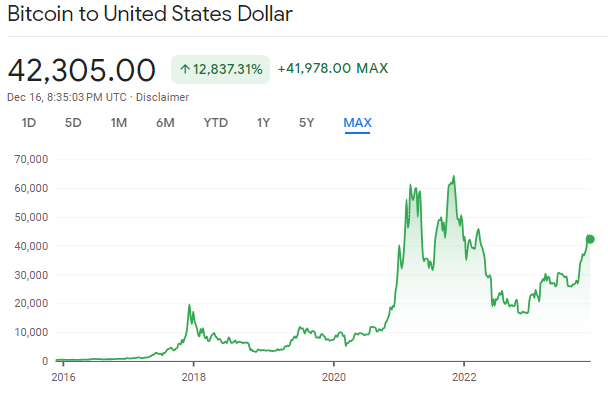
Back when I did my debate about it on May 25, 2023 it was trading at around $29,000.00, so it’s up about 45% since then. I’ve had a few people ask me recently if I’ve changed my mind on it at all since then. I’ve told them all no. I haven’t seen any facts since then that would lead me to consider changing my mind on it. In fact, the price action since then seems very reasonable given that the Fed still hasn’t popped the everything bubble that we’re living in. Stock markets are nearing all-time highs and bitcoin is doing what one should expect a ponzi-bubble to do in this environment. As I said during the debate, bitcoin could go a lot higher before it ultimately fails.
Name calling aside, I still find the entire crypto mania fascinating. It’s a great story, one that has lots of things going for it, and anyone interested in economics will be absolutely fascinated by it. I stand by my original points that I made in the debate, namely that it has three primary problems that it faces: economic problems, governmental problems, and technological problems. I’m most interested in the economic law problems that I believe it faces. My argument from day one has been that it violates Mises’s regression theorem. That is the fundamental problem and because it violates the regression theorem, it will never be stable, and that is why it is a ponzi, doomed to failure in the long run.
Crypto currencies are one more story in the long story of money historically, and I believe they could absolutely lead towards long-term changes in money. Hopefully those changes will be something positive like a market driven, gold-backed crypto currency that is not centralized around a single custodian, but rather around multiple competitive custodians. This, or something like this, could be a profound breakthrough in the cause of human liberty.
On the other hand, it could also lead to something like Fed-coin, which would be a central bank issued crypto-currency. This would be a terrible destroyer of human freedom and could lead to very dangerous centralized control on a truly horrific scale. I believe that crypto-currency is just like any other technology in that it can be used for good or for evil. The ultimate outcome will be determined by both the understanding as well as the intentions of individual human beings. In the meantime, some people will make a lot of money from the ponzi, while the majority of the naive people speculating in it will lose lots of money. As Warren Buffet has said repeatedly, this won’t end well.
Following is a well thought out essay by someone whom I respect very much. Dan Oliver is someone who has studied money and history at a very deep level, and he possesses the rare ability to write about these topics in a clear and thorough manner. He sees bitcoin very much in the way that I do and he wrote this article back in 2017.
“Bitcoin’s shortcoming is fatal: its quantity commitment is in no way a quality
commitment. It is rational to hold bitcoin only to the extent one thinks it is stable or
rising in value. It clearly is not stable, and it will rise in value only to the extent that
market participants either expect that it will one day be stable to fulfill its purpose as
money or expect that someone else will pay a higher price for it—i.e., an expanding
bubble.
Bubbles form only when there are easy monetary conditions and often around
generally hard-to-value new technologies: the canal, the railroad, radio, the internet,
and now blockchain technology. The parallels with blockchain and the internet bubble
are manifest, in fact. Casting the mind back to 1996, few people knew what “an
internet” was or why it was useful or how to get one. But there were already fortunes
being made by young innovators. It wasn’t long until wholesale money wanted in
on the game and began funding all sorts of crazy internet start-ups. When these
companies listed, Pets.com and theGlobe.com spring to mind, the public was able to
join the growing bubble to drive it to insane heights before it was left holding the bag
in the crash.”

 It's A Learning Problem